

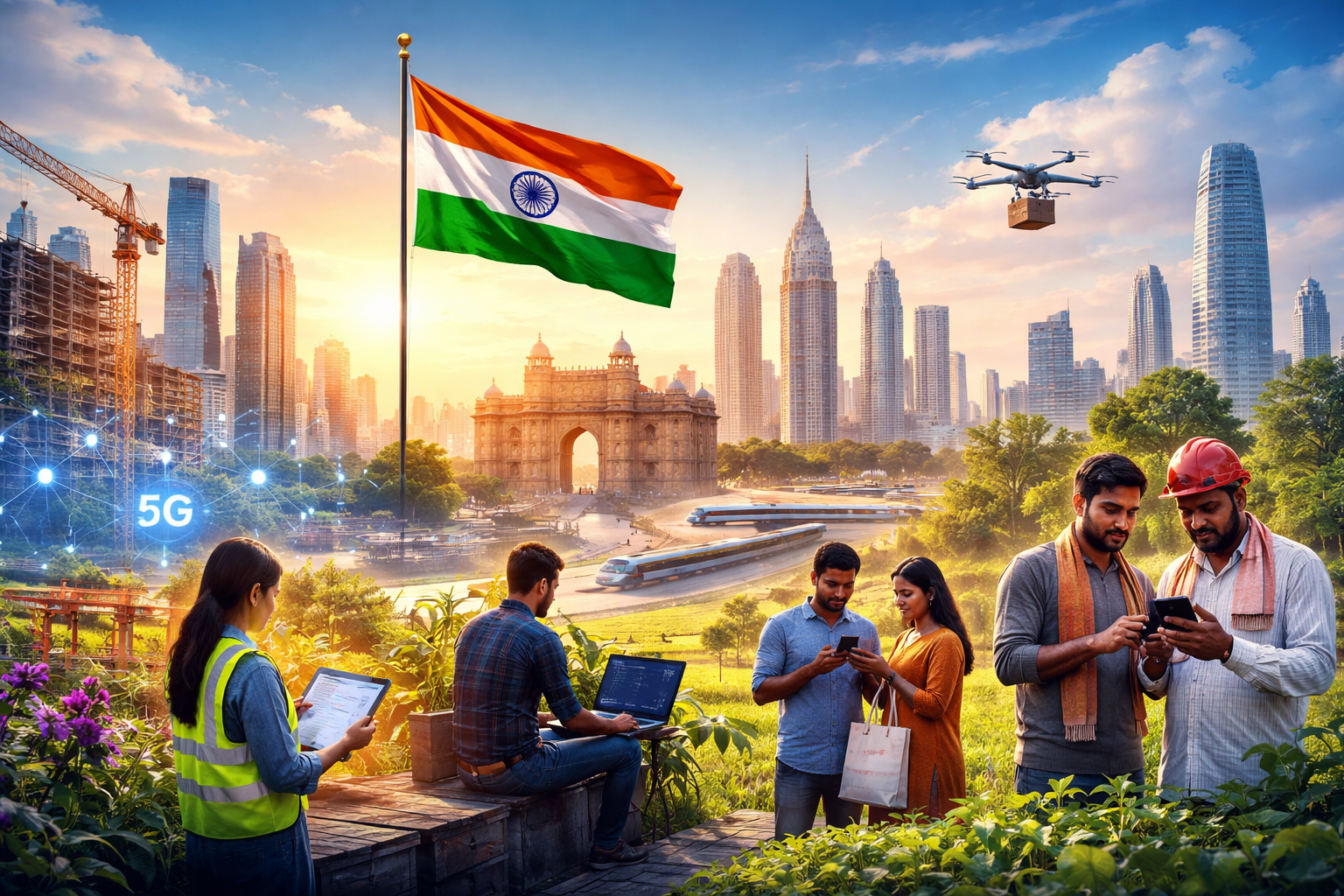
India today sits at a unique crossroads, a nation of over 1.4 billion people undergoing some of the most significant transformations in its history. From sweeping policy reforms to rapid tech adoption and shifting social dynamics, the country is evolving in ways that touch every aspect of daily life. In this blog, we explore the most consequential changes shaping India right now in society, technology, and governance and what they mean for the future.
1. Policy Shifts: Reshaping India’s Growth Landscape
a) A New Era for Labour and Work
In November 2025, the Government of India brought into force all four major Labour Codes, consolidating 29 existing laws into a unified framework covering wages, industrial relations, social security, and workplace safety. This reform simplifies compliance for businesses while extending protections and social benefits to a broader segment of workers, including those in newer gig and platform based jobs.
The labour codes aim to balance worker rights with employment flexibility, a necessary overhaul for a fast changing economy. For millions of informal and gig workers, especially in digital economies and logistics, these codes mark a shift toward formal recognition and security, including clearer wage standards and social safety nets.
b) Rural Employment Guarantees Redesigned
The Viksit Bharat Guarantee for Rozgar and Ajeevika Mission (Gramin) Act, 2025 furthers rural livelihoods by increasing statutory employment guarantee from 100 to 125 days per year for rural households. Introduced at the end of 2025, this act replaces the earlier MGNREGA framework with stronger livelihood and resilience components a vital reform for India’s agrarian and village economy.
c) Tax Reform: GST 2.0
The Goods and Services Tax 2.0 rollout in late 2025 marked another major policy upgrade. GST 2.0 was designed to modernize India’s indirect tax system, making compliance more transparent and efficient through digital interfaces, and reducing bottlenecks for businesses of all sizes.
d) Digital Rights & Social Media Regulation
In early 2026, India’s Chief Economic Adviser recommended age based limits for social media access to protect children from digital addiction and harmful content. This suggestion could lead to stricter age verification and content regulation practices, aligning India with global trends in online safety policy.
Additionally, India’s Supreme Court has recently taken up a high profile challenge to WhatsApp’s user data policy, criticizing its complexity and implications for privacy, especially for less tech savvy populations.
2. Technology Trends: From AI to Connectivity
a) India’s Strategic Tech Focus in the Union Budget
The Union Budget 2026–27 prominently prioritized advanced technologies like artificial intelligence (AI), semiconductors, and data infrastructure, signalling a strategic pivot towards becoming a technology powerhouse. This shift focuses on building domestic capabilities and supporting private sector innovation.
b) Semiconductor Mission 2.0
In February 2026, the government launched India Semiconductor Mission 2.0 (ISM 2.0) with a large budgetary outlay aimed at building a robust semiconductor and display ecosystem. This follows earlier developments where key industry players initiated fabrication and testing units, a cornerstone moves toward reducing dependence on imports and building local tech manufacturing strength.
c) AI in Public Services and Beyond
AI is no longer just a tech buzzword in India; it’s increasingly integrated into governance and public services. From AI-assisted diagnostics in healthcare platforms to predictive agriculture tools assisting farmers, the technology is delivering tangible benefits for broad populations. Robust regulatory frameworks such as the Digital Personal Data Protection Act and an AI Ethics & Safety Framework have been introduced to guide responsible deployment.
At the same time, India continues to build its AI innovation ecosystem with national missions, research centers, and language tools that support dozens of Indian languages and regional needs.
d) 5G & Connectivity Revolution
India’s telecom sector is rapidly transitioning toward 5G and Fixed Wireless Access (FWA), redefining broadband connectivity especially in smaller towns and underserved areas. This expansion empowers digital access to education, telehealth, remote work, entertainment, and entrepreneurship accelerating digital inclusion.
e) Education Reimagined
Technology is reshaping education in India. With AI tools now common in classrooms and hybrid learning expanding access, the system is transitioning from traditional credentials to modular skills development and lifelong learning. According to education analysts, 2026 will focus on measurable outcomes, industry integration, and practical skills rather than just degrees.
3. Social Shifts: Digital Behaviours and Inclusion
a) The Rise of Digital Consumers
With nearly 700 million smartphone users, India’s digital population is growing rapidly, especially in Tier-2 and Tier-3 cities. This shift has democratized access to digital services, online content creation, e-commerce, and payments, making digital life a central part of people’s economic and social identity.
Digital platforms are not only entertainment hubs but increasingly powerful tools for entrepreneurship, community voices, and innovation, with creators from smaller towns gaining national recognition.
b) Financial Inclusion: Beyond Access
While India’s financial inclusion story began with expanding bank accounts and payment systems, 2025 marked a shift toward meaningful usage and trust based outcomes. More people are now saving, borrowing, and engaging with credit, insurance, and pensions through digital tools contributing to deeper economic participation.
c) Work Life Balance & Labour Rights
Social attitudes toward work are also changing. Beyond policy reforms, discussions like the Right to Disconnect, a bill that seeks to legally allow employees to disconnect from work communications outside official hours underscore a growing focus on mental wellbeing and work life balance in a hyperconnected world.
4. The Road Ahead: What These Shifts Mean for India
India’s trajectory today is defined by ambition through transformation:
- Economic growth, underpinned by technology, reform, and inclusion.
- Improved governance, anchored in digital systems and responsive policies.
- Social empowerment, fuelled by connectivity and access.
- Innovation ecosystems, that now span AI, semiconductors, and advanced skills.
Collectively, these changes are not incremental, they’re structural. They reflect a nation intent on bridging opportunity gaps, modernizing institutions, and empowering citizens in a digital age.
For individuals and businesses alike, adapting to these shifts means embracing lifelong learning, digital literacy, and ethical technology use. For policymakers and leaders, the challenge will be to ensure these advancements remain inclusive and equitable, so that growth reaches not just urban centres, but every corner of India.